Mayslick
MAYSLICK (or Mays Lick or May’s Lick) Mayslick is a small Mason Co. community nine miles southwest of Maysville, which owes its importance to its place on the Maysville and Lexington Turnpike, now U.S. 68. For those traveling south on that route, Mayslick was the first community they came to after Washington, Ky. In 1773 William Thompson surveyed the area, and the founder of Lexington, Col. Robert Patterson, explored the area in 1775. It was a group of related families who actually established the settlement in 1787, they included brothers Abraham, Cornelius, and Isaac Drake; David Morris; and John Shotwell, along with their families. They bought 1,400 acres of land through a land agent, Judge Harry Innes. The land had been surveyed and claimed originally by William May, for whom May’s Spring and Mayslick were named.
William May was the brother of Maysville’s name sake, John May, a fact that has caused confusion over the origin of the name. The land was rolling and rich for farming, with a saltlick to provided salt for the pioneers and a large spring for water. Much of the information about early Mayslick comes from Isaac Drake’s son Daniel Drake, whose letters to his children plus some additional information were turned into a book, Pioneer Life in Kentucky. After landing at Limestone and staying for a short time in Washington in a shed built for sheep, the families moved to what became Mayslick. Isaac Drake was married to Elizabeth Shotwell, whose Quaker family strongly disapproved of her marriage to the Baptist Drake. William Wood, the Baptist minister who founded Washington, was instrumental in attracting the families to Mason Co. Pioneer life in Mayslick, as described by Daniel Drake, included log cabins, Indian problems, and the hard scrabble life of farming.
It was Abraham Drake’s tavern, where travelers stopped on their way west, that gave the town its early success. David Morris and John Shotwell also had tavern licenses. Early visitors, such as F. A. Michaux in 1793, commented on the lack of development and sophistication in the town. However, in 1810, with 132 residents, it was the third-largest town in the county. The founders were loyal to their religious convictions, establishing a Baptist church, the first in the town, in 1789. On February 1, 1837, Mayslick was incorporated, and Jonas Eddy, E. H. Herndon, John L. Kirk, Asa Runyon, and Samuel Sharp were its trustees. Among Kirk’s slaves was Elisha Green, who lived in Mayslick from 1828 to 1832 and recounts in his autobiography the hard life of a slave. Green later bought his freedom, established African American churches throughout the area, became a leader in the Republican Party, and spoke out for the rights of the freedman.
Slavery was a hot issue in the town. The Maysville Colonization Society met in Mayslick in 1823. Slaves accounted for one-third of the town’s population of 200 at the time of the Civil War.
John Hunt Morgan made his way through May slick on one of his raids, and a pro-Union meeting on October 22, 1864, attended by former governor James Robinson (1862–1863) and Governor Thomas Bramlette (1863–1867), attracted 1,000 persons.
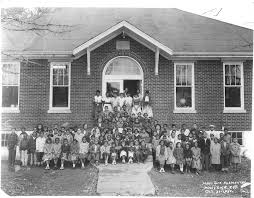
An African American school was established on August 27, 1868, after the Maysville and Lexington Turnpike company conveyed property to Stephen Breckinridge, Henry Jackson, and John Middleton, who were trustees of the Second Baptist Church. The land was to be used for a church and a school. The church stands today on the property, but neighboring property was purchased for a better school. Schools for black students were built there, the last one finished in 1921; it closed in 1960, despite a petition opposing the closure, when all black students in the county were integrated into the county system. The school building remains. Other schools flourished, both small district schools and more substantial private schools.
The Baptists had schools from the beginning, such as the one that Daniel Drake attended. James Blaine, later U.S. secretary of state, is believed to have taught at Mayslick, perhaps while he also taught in the 1840s at the Western Military Institute at Blue Licks, just 10 miles southwest on the Maysville and Lexington Turnpike. Hedge College was a late-19th-century private school. In 1909 a public high school opened in Mayslick. In 1910, a Shannon Creek flood washed away a small rural school called Arthuranna. Local citizens then lobbied to consolidate that school and the schools at West Liberty, Mayslick, and Peed, along with part of the Helena Station district. It became the first consolidated school with transportation in Kentucky; horse-drawn buses transported students. A three-story brick school was started in 1909, and a gym was added in 1929. Mayslick High School closed in 1960 and was consolidated into Mason Co. High School. It had previously taken in the students from the closed Sardis, Lewisburg, and Washington schools. Before consolidation, the school was the center of the community, which had grown to more than 300 residents in the early 20th century. For example, in 1931, the team of eight Mayslick High School girls won the basketball district tournament and reached the final four in the state championship.
Mayslick had many churches over the years. The role of the Mayslick Christian Church at a historic turning point stands out. In the late 1820s, Thomas and Alexander Campbell preached in the area, and as a result the Mayslick Christian Church, one of the first Disciples of Christ churches, was established in 1830. The Disciples of Christ, which had grown out of the Cane Ridge movement, became a distinct denomination at about the same time. Walter Scott, another founder of the Disciples of Christ, later was pastor of the church in Mayslick and is buried in the community cemetery. The Mayslick Christian Church, where Scott became the first full-time pastor, was built 1841 by Lewis Wernwag, a prolific covered-bridge builder.
The Mayslick Baptist Church suffered a loss of membership when the Campbellites left, but the church nevertheless proceeded to outgrow several structures and today worships in a building enlarged around the 1870 church. Both the Baptist and the Christian churches had black members but eventually sponsored separate churches for African American members. The Second Baptist Church began in 1855 with more than 100 members and has worshipped in the same church building since 1913. The Second Christian Church congregation began worship in their own church in 1889, but the church closed a century later. The Presbyterian Church, which started on Johnson Fork in 1793 and moved to Mayslick in 1850, now has only a few members. Bricks from the original church were used in the 1850 structure and in the 1876 rebuilding after a fire. That church, with some of the 18th-century bricks, stands today.
After the mid-19th-century influx of mostly Catholic immigrants from Ireland and Germany, Rev. John Hickey was appointed in 1864 to serve the needs of them and other Catholics in the area. A church building at Mayslick was purchased from the Methodist Episcopal South Church in 1867 for $600, another church was built in 1886, and the present St. Rose of Lima Church was built in 1928.
Still today many of the farming families in the Mayslick area, descendants of the 19th-century immigrants, have Irish or German names.
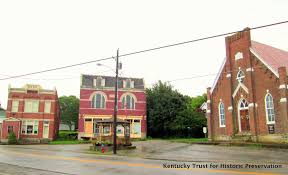
In the early 20th century, a new bank opened in Mayslick; the Farmer’s Bank of Mayslick was chartered in 1902 and remained in some form until the 1990s in the same building. Beside the brick bank building, an impressive Independent Order of Odd Fellows Hall was built in 1904 with a second floor large enough to house a skating rink at one time. Both buildings stand in 2020.
The community was a hot spot during the tobacco wars, having an active group of Night Riders in the first decade of the 20th century. Large estates and plantations were established in the Mayslick area. It was called the “asparagus bed” of Mason Co., as it was believed to be the site of richest farmland. In the mid-1800s, the Mayslick Importing Company did a thriving business in mule breeding stock. Agricultural fairs were held in the early 1900s, and impressive houses built from the settlement period to the early 1900s dot the area. Examples include a stone house believed to be built by Thomas Metcalfe, who was called Stonehammer at the time but later was elected governor of Kentucky. Another unique example is the William Pepper Fox house, built in 1854, which had an entrance hall that measured 14 by 30 feet.
On this estate is Fox Field, a federally protected Fort Ancient archaeological site. What is known as the Longnecker house was finished in 1825; its front door shows damage from the buckshot fired by tobacco Night Riders. James Mitchell, president of the First National Bank of Maysville, picked one of the highest spots in the county near Mayslick to build his home, Maplewood, in 1889; it is a Romanesque showplace with stained glass and impressive stonework. In that same year, Charles Young, who was born in a log cabin just down the road from Maplewood, became only the third African American to graduate from the U.S. Military Academy at West Point, N.Y., and the first in a generation.
Today, the town square of Mayslick is no longer active with its former hardware store, pool hall, grocery stores, bank, and other businesses. A few businesses remain, along with the churches and a large number of homes, which continue to be built in the area for those who want country living only a short distance away from work. The area has flashes from the past in the significant number of older Amish people who have moved into the Mayslick area in the past decade. They are active members of the community, participating in community events, and their horses and buggies are common sights on the local roads.
Mayslick became the name of the town after it had first been called May’s Spring. Mayslick came into common usage in the 20th century, and today both spellings are used, along with Mays Lick and May’s Lick.
Calvert, Jean, and John Klee. The Towns of Mason County. Their Past in Pictures. Maysville, Ky. Maysville and Mason Co. Library Historical and Scientific Association, 1986.
Clift, G. Glenn. History of Maysville and Mason County. Lexington, Ky. Transylvania, 1936.
Collins, Richard H. History of Kentucky. Vol. 1. Covington, Ky. Collins, 1882.
David, Lynn, and Liz Comer. ” Mayslick: Asparagus Bed of Mason County.” NKH 12, no. 2 (Spring Summer 2005): 37–49.
Rennick, Robert M. Kentucky Place Names. Lexington: Univ. of Kentucky Press, 1984.
John Klee
Above excerpted from page 593 – 595 of THE ENCYCLOPEDIA OF NORTHERN KENTUCKY THE UNIVERSITY PRESS OF KENTUCKY ISBN 978-0-8131-2565-7